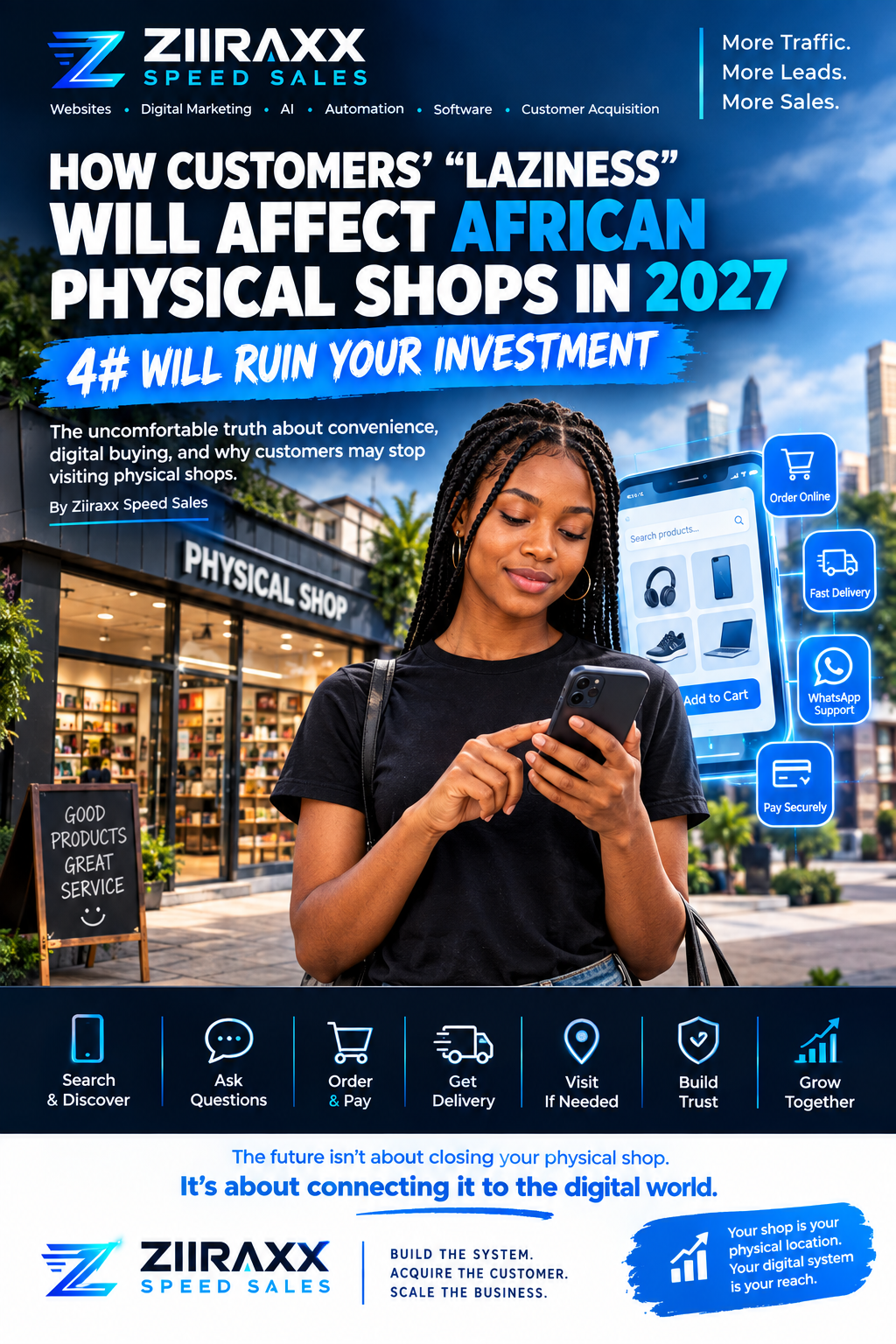
Introduction: Customers are not necessarily lazy — they are demanding more convenience.
Let us be honest. Customers do not always want to travel. They do not always want to enter a shop. They do not always want to stand in a queue. They do not always want to ask a salesperson ten questions. And they certainly do not want to spend an hour doing something they believe they could do from their phone in five minutes.
What businesses sometimes call “customer laziness” is often something more powerful: the demand for convenience.
Across Africa, customers are increasingly using phones and digital platforms to discover businesses, compare products, communicate with sellers, make payments, and arrange deliveries.
This creates a new challenge for physical shops. A physical shop can still be valuable. But if an entire business depends on customers physically visiting, changing customer behavior can create serious pressure.
Here are 7 ways customer convenience could affect African physical shops in 2027.
1. “I do not want to come there.”
Imagine a customer wants your product. But getting to your shop requires transportation, traffic, parking, walking, waiting, and time. Then they discover another business offering the ability to browse online, ask questions, order, pay, and receive delivery.
What do you think the customer is likely to consider? The product may be similar. The difference is convenience.
This is why a physical shop should not necessarily be the only place where customers can interact with a business. A website can become an additional storefront. WhatsApp can become an additional sales channel. Digital advertising can become an additional customer-acquisition channel. Delivery can bring products to the customer instead of always requiring the customer to come to the shop.
In 2027, convenience can become part of the customer experience.
2. “I want to know the price before I come.”
Customers increasingly want information before making a journey. They may want to know how much it costs, whether it is available, what options they have, where you are located, how long delivery takes, and whether they can order online.
If the customer has to physically visit a shop just to get basic information, the business is adding friction to the buying process. A digital system can remove some of that friction.
A website can display products, services, prices where appropriate, photos, specifications, FAQs, reviews, contact options, and ordering options. An AI chatbot can help answer common questions. WhatsApp can handle direct conversations. Now the customer can do their research before deciding whether to visit.
Do not make your customer travel just to discover whether you can solve their problem.
3. “I do not want to wait.”
This is where convenience becomes serious. Customers have become accustomed to fast digital interactions. They can search for information within seconds, send a WhatsApp message, order online, make payments digitally, and arrange delivery.
That changes expectations. Now imagine a customer enters a physical shop and has to wait 30 minutes before getting assistance. At another business, they can get information immediately through a website or automated system.
The difference is not necessarily the product. It is the experience. Physical businesses can use technology to reduce unnecessary waiting. A website, product selection, online enquiry, AI assistance, order or booking, and human support when necessary can create a smoother experience.
4. The one that could ruin your plan: “Why should I leave my house?”
This is the big one.
Imagine investing heavily in shop rent, interior design, shelves, signage, equipment, stock, staff, security, electricity, branding, and more. Then customers discover they can get what they need without leaving home.
The investment does not automatically become worthless. But the assumption about how customers will reach the business may become outdated. That is the real danger.
You built the business around: Customer → Shop. But the customer increasingly expects: Customer → Phone → Business. And that changes the infrastructure a business needs.
The physical shop can still serve an important purpose. But it should be connected to digital channels. Customers should not have only one way to buy from a business.
5. The horror of being limited to foot traffic
A physical shop depends heavily on its surroundings: the number of people passing by, accessibility, transportation, traffic, nearby businesses, and local demand. But digital marketing can introduce a business to people who may never have passed the shop.
A customer could be sitting at home in Lagos and discover a business through Google. Another could be in Abuja, Port Harcourt, Accra, or Johannesburg. The physical shop has a location. The internet gives the business an opportunity to expand its reach beyond that location.
This does not mean every business needs to sell internationally. It means a business should understand that its potential market does not necessarily end at its physical address.
6. The customer who wants everything done for them
A customer may not want to call repeatedly, explain the same thing twice, fill out complicated forms, travel unnecessarily, wait for basic answers, or visit multiple shops to compare options. They want the process to be simple.
This is where automation becomes valuable. Imagine a customer visits your website, an AI chatbot asks what they need, they select an option, the system provides relevant information, they submit their details, and the business receives the enquiry and follows up.
The customer does not have to figure out the entire business process. Your system guides them.
7. The horror of having no customer-acquisition system
This is the biggest problem. A physical shop gives a business a location. But location is not the same as customer acquisition. A business needs a system that answers:
- How do people discover us?
- How do they trust us?
- How do they ask questions?
- How do we capture their information?
- How do we follow up?
- How do they buy?
- How do we bring them back?
A modern business can connect these stages:
Traffic → Website → Trust → Enquiry → AI / Human Response → Follow-up → Sale → Repeat Customer
Now the physical shop becomes one part of the business, rather than the entire business.
The 2027 question
The question is not, “Should physical shops close?” That is the wrong question for many businesses. The better question is: “If customers stop walking into my shop, does my business still have a way to find them?”
If the answer is no, the business may be overly dependent on foot traffic. The physical location can remain. But the business should start building a digital layer around it.
Turn a physical shop into a digital business
Imagine a physical shop connected to:
- A professional website as your digital storefront
- Digital marketing to attract potential customers
- AI customer support to answer common questions
- WhatsApp sales to move interested customers into direct conversations
- A customer database to keep valuable prospect information organized
- Automation to reduce repetitive manual work
- Online payments to make purchasing easier
- Delivery to allow products to reach customers beyond the immediate location
- Analytics to show where customers and enquiries are coming from
The physical shop is not dead. The physical-only model is the real risk.
The new customer journey
The traditional model: See shop → Enter shop → Ask → Buy.
But the modern hybrid model can look like: Advertisement / search → Website → Product or service information → AI chatbot / WhatsApp → Enquiry → Payment / booking / order → Delivery or shop visit → Customer → Follow-up → Repeat purchase.
The physical shop becomes one part of the customer journey instead of the entire journey.
The Ziiraxx Speed Sales approach
At Ziiraxx Speed Sales, we focus on the digital infrastructure surrounding customer acquisition. That can include professional websites, digital marketing, AI chatbots, customer acquisition systems, business software, automation, lead capture, and online sales systems.
The objective is simple: do not force customers to come to the business before the business can serve them. Instead, bring the business to the customer. Let them discover you, ask questions, understand your offer, contact you, order where appropriate, and give the physical location a role inside a larger digital system.
2027 customer-convenience checklist
- Can customers find the business online?
- Is there a professional website?
- Can customers enquire outside business hours?
- Is customer information captured?
- Is there a follow-up system?
- Can customers order without physically visiting?
- Can the business advertise beyond its immediate location?
- Is it possible to know where customers are coming from?
- Can software reduce repetitive work?
- If foot traffic drops tomorrow, is there another customer-acquisition channel?
If several answers are “no”, the business may have a digital infrastructure gap.
The future of the physical shop
The future does not necessarily mean no physical shops. It means physical shops with digital infrastructure.
A shop can remain the place where customers visit, experience, inspect, collect, and meet the team. But the digital system can become the place where customers discover, research, ask, order, pay, and follow up.
Final thought
The question is not, “Will customers become too lazy to visit physical shops?” The better question is: “How much effort does a business require customers to make before they can buy?”
Every unnecessary step creates friction. And every piece of friction creates an opportunity for another business to say, “We will make it easier.”
A physical shop is an asset. Do not abandon it. Connect it to a website, customers, advertising, WhatsApp, software, automation, and a customer-acquisition system.
Because in 2027, businesses that understand convenience will not necessarily ask customers to come closer. They will build systems that make buying easier.
Ziiraxx Speed Sales
Build the System. Acquire the Customer. Scale the Business.
Websites • Digital Marketing • AI • Automation • Software • Customer Acquisition
Your shop is your physical location. Your digital system is your reach.